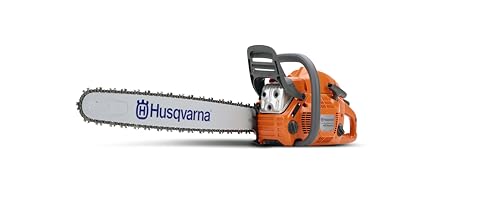
The Husqvarna 460 Rancher is the biggest gas saw in our ranking and the one that most resembles a working-pro tool sold to homeowners. Husqvarna describes it as “professional power at home,” pairs a 60.3 cc X-Torq engine with a 24-inch bar on this listing, and puts it at the top of the Rancher family for people who regularly cut thick wood. It sits in the premium range of the saws we cover, and it is a different kind of purchase from a battery saw you grab for a few fallen limbs.
This profile goes through what Husqvarna publishes about the saw, how those numbers translate to a property in the US, and where the saw is probably the wrong tool. We do not run these saws ourselves, so every spec below comes from Husqvarna’s own product page. Where Husqvarna does not publish something, we say so. For how it compares against the rest of the field, see our chainsaw ranking for 2026.
What Husqvarna Says About the 460 Rancher
According to Husqvarna’s US product page:
- Engine: 60.3 cc X-Torq two-stroke, 3.62 hp output shaft power (net, per ISO 7293), maximum torque 3.4 Nm at 7,000 rpm.
- Chain speed: 65.62 ft/s at maximum power.
- Bar and chain on this listing: 24 inches, 3/8-inch pitch, .058-inch gauge, X-Cut chain type S83G, with a sprocket nose and mounted spikes. The recommended bar range is 13 to 24 inches.
- Weight: 13.2 lb excluding the cutting equipment (bar and chain), so the working weight is higher.
- Sound: 105 dB(A) sound pressure at the operator’s ear; 115 dB(A) guaranteed sound power level.
- Vibration: 6.9 m/s² at the rear handle and 3.8 m/s² at the front handle.
- Lubrication: automatic oil pump with an adjustable output of 6 to 17 ml/min, chain oil tank of 0.7 US pint, and fuel mixed 50:1 with Husqvarna 2-stroke oil or equivalent.
- Features listed: LowVib dampeners, Smart Start, air purge, decompression valve, Air Injection centrifugal air cleaning, quick-release air filter, side-mounted chain tensioner, felling marks, a “no oil at idle” function and an inertia-activated chain brake.
Use the button at the bottom of this page to see the current listing on Amazon.
Reading the Numbers
Engine size and bar length go together. A 60 cc class engine is what makes a 24-inch bar practical. Driving a long bar and chain through dense hardwood takes torque and chain speed, and a smaller saw pushed too hard through the same cut will bog down and wear faster. Husqvarna’s own advice is to use an X-Cut chain on the full 24-inch length in hardwoods. If you will never use more than 16 or 18 inches of bar, a smaller saw such as the Husqvarna 450X Rancher is the more sensible machine.
Weight is the trade-off. At 13.2 lb before the bar and chain are fitted, plus fuel and oil, this saw is in a different class from the cordless options. Over a morning of bucking firewood you will feel that, and you will notice it more when you cut at awkward angles. Husqvarna’s LowVib dampeners are designed to reduce hand and arm vibration, and the listed figures are 6.9 m/s² at the rear handle and 3.8 m/s² at the front, but fatigue is still a safety factor, and OSHA’s chainsaw fact sheet says to take breaks as needed because fatigue increases the risk of injury.
It is loud. Husqvarna lists 105 dB(A) at the operator’s ear. That is why hearing protection belongs on every list of gear for gas saws, and why it is a poor choice for a tight suburban lot early on a Sunday morning. For quieter work, a battery saw is the usual path.
Starting aids matter on a saw this size. The decompression valve, Smart Start and air purge are all aimed at making a high-compression 60 cc engine easier to pull over. Husqvarna’s FAQ says the decompression valve reduces pull force by roughly 50 percent. Cold-weather starting is a common frustration with gas saws, so these features are worth having, though no starting system removes the need to follow the manual’s procedure.
Who the 460 Rancher Suits
This saw makes sense if:
- You cut a lot of firewood each season, especially in larger-diameter hardwoods, and you want a saw that holds chain speed under load.
- You live on acreage or a rural property where storm cleanup often means big logs, not twigs.
- You are comfortable with two-stroke fuel mixing, air filter cleaning, spark plug checks and chain sharpening, and you have a place to store fuel safely.
- You want a long bar for bucking thick logs and are willing to carry the weight.
Who Should Look Elsewhere
You may be happier with a different saw if:
- Your yard is small and your jobs are limbs and branches. A 24-inch bar on a 13.2 lb saw is far more than you need. A lighter battery saw like the Husqvarna Power Axe 350i or a compact entry-level model is easier to live with.
- You want a quiet saw or one without fuel. Two-stroke gas saws are loud and need mixed fuel. A 20-inch battery saw such as the EGO CS2005 or the DEWALT DCCS677Z1 covers firewood with no fuel mixing and without an engine’s noise.
- You are new to chainsaws. A powerful, heavy saw is not a gentle first tool. If you are new, start with a smaller saw and proper training.
- You expect to fell large trees yourself. See the safety section below.
Bar, Chain and Maintenance
The 24-inch bar on this listing is a 3/8-inch pitch with a .058-inch gauge. When you buy a replacement chain, match the pitch, gauge and drive link count printed on the bar or listed in your manual. Husqvarna recommends its X-Cut C85 chain for hardwood on this saw and notes that a semi-chisel chain may stay sharp longer in dirty or frozen wood, though it cuts a bit slower.
The 460 Rancher uses an adjustable oil pump, set with a flathead screwdriver on the underside of the saw. Husqvarna’s FAQ suggests raising oil flow for a 24-inch bar and lowering it for shorter bars, so the chain stays lubricated without wasting oil. Check the chain oil level every time you fuel up. The oil tank is separate from the fuel tank, and a dry chain wears the bar and chain quickly.
Chain sharpness is one of the biggest factors in cutting speed and effort. OSHA’s QuickCard says to make sure the chain is always sharp and the oil tank is full before you start. A filing guide and a few minutes with a round file will keep a chain in shape between sessions. Keep the quick-release air filter clean, because sawdust and debris reduce engine performance. Plan for fuel storage too: use fresh mixed fuel, and follow the manual’s guidance for long storage.
Safety Notes for a Saw This Size
Gas chainsaws are covered by ANSI B175.1, which Oregon describes as the safety standard for gasoline-powered chainsaws sold in the US. Oregon’s explanation is that saws under 3.8 cubic inches (62 cc) must meet low-kickback provisions, while larger saws may or may not and carry a kickback warning if they do not. The 460 Rancher’s 60.3 cc displacement is under that line, but Husqvarna’s product page does not state ANSI B175.1 compliance, so read the labels and manual on the saw you receive. See Oregon’s ANSI B175.1 explanation for how the standard divides saws. Husqvarna lists an inertia-activated chain brake on this model, designed to reduce the likelihood of injury from kickback.
Kickback is the sudden upward and backward movement of the bar. Oregon calls the upper tip of the bar the “kickback danger zone” and says never to saw with that area. See Oregon’s chainsaw safety page. OSHA’s chain saw QuickCard says to start the saw on the ground or another firm support with the chain brake engaged, at least 10 feet from the fueling area, never to fuel a running or hot saw, and to wear hand, foot, leg, eye, face, hearing and head protection. In practice, that means cut-resistant chaps, a hard hat, safety glasses or a face shield, hearing protection, gloves and sturdy boots.
OSHA’s logging standard, 29 CFR 1910.266, sets chain brake, leg protection and starting requirements for logging employers. It is not a legal duty for homeowners, but it is a good picture of what working crews are expected to do. If you need to take down a large tree, a tree close to a house or power lines, or a storm-damaged tree that may be under tension, hire a licensed and insured tree service or a certified arborist. OSHA’s chainsaw fact sheet lists trees with a heavy lean, stem or root rot, or on unstable ground as higher-risk work. No saw and no gear makes a hazardous job safe, so always follow the owner’s manual.
Emissions and Where You Live
California’s Air Resources Board regulates small off-road engines, which include gasoline chainsaw engines. The product page we read does not say whether this model is sold in all 50 states or carries a particular California certification, so check the Amazon listing and the saw’s labels if you live in California or another state that follows California’s rules. See the CARB small off-road engines program page.
Bottom Line
The Husqvarna 460 Rancher is a big-engine homeowner saw for people who actually need the power: heavy firewood, thick logs and long bars. Its listed 60.3 cc engine, 24-inch bar, adjustable oil pump and starting aids make sense on a large property. Its weight, noise and fuel upkeep make it a poor fit for anyone whose jobs are branches and light cleanup. If that describes you, compare it against the battery saws in our ranking, and if big or hazardous trees are on your list, call a professional. Use the button below to see the current listing on Amazon and confirm the bar length and what ships in the box.
See price on Amazon
Sources