We earn a commission if you buy through our links, at no extra cost to you.
Best Chainsaw for Women: Lighter, Easy-Start Saws
A lighter, easier-starting chainsaw for any user who wants less weight and less fuss: what weight figures mean, handling, battery vs gas and four models.
At a glance
For a lighter, easier-starting chainsaw, the Husqvarna Power Axe 350i is a 7.72-pound battery saw excluding battery and cutting equipment. The EGO CS1815 adds an 18-inch bar and a 6.0Ah battery, and the DEWALT DCCS621P1 is a 12-inch saw for limbs. Wear leg, eye, ear and head protection.
This guide is for anyone who wants a chainsaw that is lighter, easier to start and easier to keep under control. It is about the saw and the job, not about who you are: a smaller person, a first-time owner, someone with a sore shoulder or anyone tired of fighting a pull cord will all want the same things. Weight, balance, handle reach and how the saw starts matter more than the logo on the side.
We do not run these saws ourselves. Specs come from the makers’ own product pages and from public safety sources listed at the end. Weights are a place where makers are not consistent, so we only quote figures that a maker or a named source publishes and say what each figure includes. Where no weight is published, we say that. We show no prices; use the Amazon buttons. For the whole field, see our 2026 chainsaw ranking.
What Weight Figures Actually Mean
A single number on a spec sheet can hide a lot. Husqvarna lists the Power Axe 350i at 7.72 lb excluding the battery and cutting equipment. The 435 is 9.78 lb excluding the bar and chain. EGO does not publish a weight for the CS1815 on its product page. These two numbers do not compare directly, because each leaves out different parts and neither includes fuel or a battery.
Two practical points follow. First, the saw you lift is heavier than its listed weight: add the bar, the chain, the battery or a tank of fuel and mix. Second, weight out front matters more than total weight, which is why a shorter bar helps. If weight matters to you, check the manual for what is included and, if you can, hold the saw in a store before you buy.
Battery, Gas or Corded for Easy Starting
For a user who wants the least friction, a battery saw is the straightforward choice. Husqvarna says the Power Axe starts with a push of a button, with no choke and no cord pulling. EGO’s saws use the same idea. That removes the pull-start motion and the fuel mixing, both common reasons people avoid gas saws.
Gas saws are not out of the question. Husqvarna lists Smart Start and air purge on the 435 to ease starting, plus a 9.78 lb weight without bar and chain, which is on the light side for gas. It still has a pull cord and needs mixed fuel at 50:1, and Husqvarna lists 102 dB(A) at the operator’s ear. The Power Axe lists 91 dB(A). Either way, wear hearing protection.
Corded electric saws are light on upkeep but tie you to a cord. If your work is near an outlet, they are fine; for a downed limb in the back lot, a battery saw is more practical.
Handling: Bar Length, Balance and Reach
- Bar length. Pick the shortest bar that covers your jobs. A 12-inch bar is easiest to steer and suits branches. Eighteen inches adds reach for small logs. The University of Arkansas Cooperative Extension says to choose the proper size saw and bar length to match the job.
- Balance. A saw that feels nose-heavy tires the arms. If you can, pick the saw up and hold it as you would to cut, with both hands on the handles.
- Handle fit. Reach and grip matter. If you wear thick gloves, make sure you can still work the trigger and the brake.
- Chain tensioning. Tool-less tensioning is on the Power Axe, the EGO CS1815 and the Oregon CS1500, according to the makers. It means you do not have to hunt for a wrench to adjust a chain that has stretched.
Safety Does Not Scale With Weight
A lighter saw is easier to hold steady, but it does not cut less. OSHA’s chain saw QuickCard says the proper protective equipment includes hand, foot, leg, eye, face, hearing and head protection, and that loose clothing should be avoided. Wear chaps or other leg protection, a hard hat with face protection or safety glasses, ear protection, gloves and sturdy boots.
Kickback is the same on a small saw. Oregon calls the top of the bar tip the kickback danger zone and says never to cut with it. OSHA says to start the saw on the ground or on a firm support with the chain brake engaged, to keep both hands on the handles with secure footing, and never to drop start. Oregon also explains that, under ANSI B175.1, gasoline saws under 3.8 cubic inches (62 cc) must meet low-kickback provisions, and all chains can kick back. We do not claim any model meets that standard unless its maker says so. Follow the manual and take an in-person class if you can.
Know the Limits of a Light Saw
A light saw is for limbs, storm cleanup, small logs and trimming. It is not for felling a big tree. OSHA’s fact sheet lists trees with a heavy lean, trees on unstable ground and trees with rot as higher-risk work, and says to keep other people away from a tree being felled by at least twice its height. Trees near a house, a fence or power lines, and storm-damaged trees with wood under tension, are jobs for a licensed, insured tree service or a certified arborist. We give no felling steps.
Husqvarna Power Axe 350i — The Lightest Listed Weight
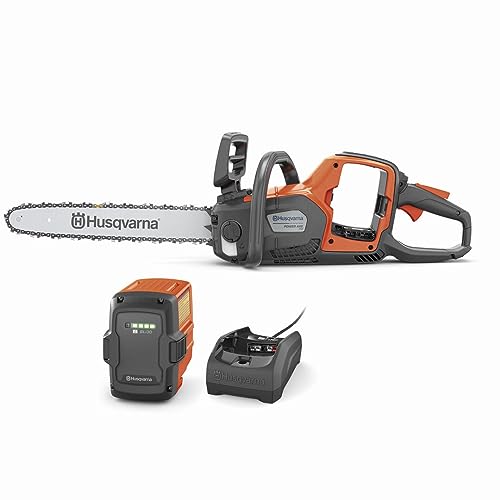
For users who want the lowest listed weight in our lineup, push-button starting and a quieter saw with an 18-inch bar. Kit includes battery and charger.
According to Husqvarna, the Power Axe 350i is a 40V brushless saw with an 18-inch bar, 1.9 hp and a chain speed of 38.7 ft/s. The kit includes a BLi30 battery and a 40-C80 charger. It weighs 7.72 lb excluding the battery and cutting equipment, and Husqvarna lists 91 dB(A) at the operator’s ear and tool-less chain tensioning. It is in the mid-range tier of our ranking. The battery adds weight, so hold it with the battery attached. See the Power Axe 350i profile.
EGO POWER+ CS1815 — An 18-Inch Saw With Easy Controls
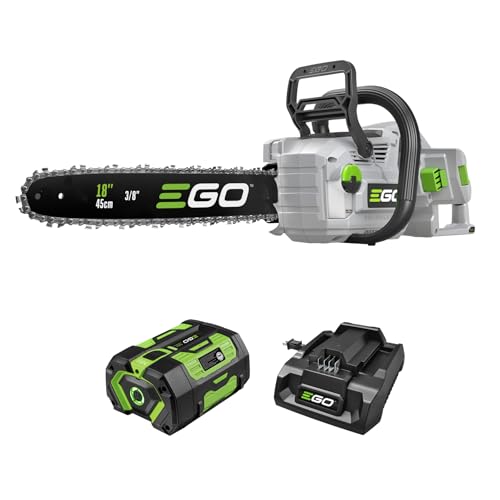
For users who want a battery saw with a tool-free tension dial and an LED display, and who may already own EGO 56V tools. Kit includes a 6.0Ah battery and charger.
EGO lists a 2500W brushless motor, an 18-inch bar, a digital display with speed modes and an adjustable LED light. It lists up to 330 cuts on a 4x4 per charge with its battery, a figure under EGO’s own conditions. EGO’s product page gives no weight, so check the manual or the listing if weight is your main concern. What it offers over the Power Axe is a larger battery family shared with EGO’s other outdoor tools. See the EGO CS1815 profile.
DEWALT DCCS621P1 — A 12-Inch Saw for Limbs
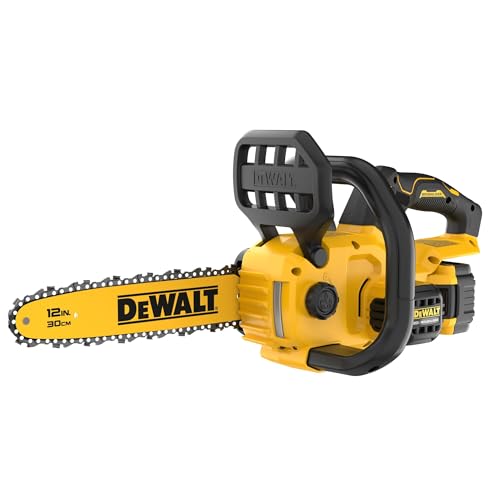
For users who mainly trim limbs and branches, want a short, controllable bar and already use DEWALT 20V MAX batteries.
DEWALT calls the DCCS621P1 a compact brushless saw with a 12-inch low-kickback bar and chain, designed for cutting tree limbs and branches, and describes it as lightweight. DEWALT’s product page does not publish a weight, so we cannot compare it in pounds; the short bar and the 20V MAX battery are the clues to its size. The page lists a DCB205 battery and a tensioning tool in the kit, so check the listing to see whether a charger is included. See the DCCS621P1 profile.
Husqvarna 435 — A Light Gas Saw if You Prefer Gas
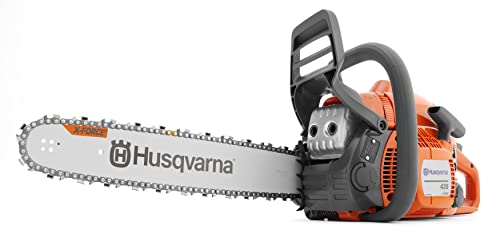
For users who want gas runtime in a compact 16-inch saw and are comfortable with fuel mixing and a pull start. Entry-level tier of our ranking.
Husqvarna lists 40.9 cc, 2.2 hp, a 16-inch bar and 9.78 lb without the bar and chain. Smart Start and air purge are meant to make starting easier, and the page lists an inertia-activated chain brake. It is the loudest saw here, at 102 dB(A). See the Husqvarna 435 profile.
How to Choose
- Lowest listed weight, push-button start: the Power Axe 350i.
- More battery and an 18-inch bar, with EGO tools: the CS1815.
- Limbs only, DEWALT batteries on hand: the DCCS621P1.
- Prefer gas: the Husqvarna 435.
The full ranking covers larger saws.
Sources
- OSHA QuickCard: Chain Saw Safety
- OSHA Fact Sheet: Working Safely with Chainsaws
- Oregon: ANSI B175.1 and replacement chain
- Oregon: Chainsaw safety and the kickback danger zone
- University of Arkansas Cooperative Extension: chainsaw safety (FSA-1009)
- Husqvarna Power Axe 350i official product page
- Husqvarna 435 official product page
- EGO POWER+ 18” Chain Saw (CS1810 / CS1815) official product page
- DEWALT DCCS621P1 official product page
Frequently asked questions
What makes a chainsaw lighter and easier to handle?
Three things: a shorter bar, a battery motor instead of a gas engine, and a body built for balance. A 12- to 18-inch bar puts less weight out front. A battery saw also drops the pull cord and the fuel mix. Weight figures vary in what they include, so read whether the number counts the bar, chain and battery.
How much do these saws weigh?
Husqvarna lists 7.72 lb for the Power Axe 350i excluding the battery and cutting equipment, and 9.78 lb for the 435 excluding bar and chain. EGO and DEWALT do not publish a weight for the CS1815 or the DCCS621P1 on their product pages, so we give none.
Is a battery chainsaw easier to start than a gas one?
Yes, in the sense that there is nothing to pull or prime. Husqvarna says the Power Axe starts with a push of a button, with no choke and no cord pulling. Gas saws such as the Husqvarna 435 add Smart Start and air purge to ease starting, but still use a pull cord and mixed fuel.
What bar length is best for a lighter saw?
For limbs and small logs, 12 to 18 inches is plenty. The DEWALT DCCS621P1 uses a 12-inch bar, while the Husqvarna Power Axe 350i and EGO CS1815 use 18-inch bars. Pick the shortest bar that covers your work, since a shorter bar is easier to control.
Does a lighter saw mean a safer saw?
No. A lighter saw is easier to hold steady, but it can still kick back and cut. OSHA's chain saw QuickCard says to wear hand, foot, leg, eye, face, hearing and head protection, to start the saw on the ground with the brake engaged and never to saw with the tip of the bar.
Can I use a lightweight saw to cut down a tree?
Use it for limbs, storm cleanup and logs on the ground. For felling large trees, trees near a house or power lines and storm-damaged trees under tension, hire a licensed, insured tree service or a certified arborist.