We earn a commission if you buy through our links, at no extra cost to you.
Best Chainsaw for Beginners: Your First Saw
Buying a first chainsaw: battery vs gas vs corded, bar length, chain brake, low-kickback chain and protective gear, plus four beginner-friendly models.
At a glance
For a first chainsaw, the EGO POWER+ CS1815 is an 18-inch battery saw with no pull cord or fuel mix. The Husqvarna 435 is a compact gas option, and the Oregon CS1500 is a corded electric saw with a chain brake. Pair any of them with chaps, eye, ear and head protection.
A first chainsaw is a different purchase from a first drill. The tool is simple, but it asks you to bring some of the safety yourself: the right gear, a sharp chain, a plan for each cut and the judgment to stop when a job is too big. The good news is that most homeowner work is modest. Fallen limbs after a storm, a few rounds for the fire pit, a damaged branch hanging over the shed. This guide covers what to look for in a beginner saw, the gear you need before you start the saw, and four models from our ranking that fit a first-time buyer.
We do not run these saws ourselves. Specs below come from the makers’ product pages and from public safety sources listed at the end, and when a maker does not publish a figure, we say so. We show no prices here: use the Amazon buttons for current pricing. For the whole field, see our 2026 chainsaw ranking.
Battery, Gas or Corded: Pick the Power Source First
This is the biggest decision for a beginner, because it decides how the saw starts, how loud it is and how much upkeep it needs.
- Battery (cordless). You push a button and cut. There is no pull cord, no choke and no fuel to mix, which removes the steps beginners most often get wrong. The trade-off is runtime and lock-in: the battery sets how long you work, and batteries only fit the same maker’s platform. A household that already owns EGO or DEWALT tools has a head start.
- Gas. A gas saw gives you the longest runtime and works anywhere, but you mix gasoline and 2-stroke oil, pull a starter cord and keep the engine tuned. Husqvarna lists 50:1 mix for the 435. It also runs loud: Husqvarna gives 102 dB(A) at the operator’s ear for the 435, so hearing protection is a must.
- Corded electric. Instant start and the lowest upkeep, but you are limited by cord reach and you need an outdoor-rated extension cord of the gauge the manual specifies. Good for a small yard with an outlet nearby, a poor match for a downed tree at the back of a property.
If your work is limbs and storm debris near the house, a battery or corded saw is usually the gentler start. If you cut firewood regularly or work far from power, a compact gas saw can make sense, as long as you are willing to learn fuel handling.
Choose a Bar Length You Can Control
The bar is the metal blade the chain runs around. A common rule of thumb is that a bar should be a few inches longer than the wood you cut, since the saw cuts from one side. A longer bar is not better for a beginner: it adds weight at the front, it is harder to keep steady, and the engine or motor has to pull a longer chain.
Most first-time buyers do well with a bar between 14 and 18 inches. The University of Arkansas Cooperative Extension chainsaw safety guide says to choose the proper size saw and bar length to match the job. A 16-inch bar, like the one on the Husqvarna 435, handles limbs and logs up to roughly that width. An 18-inch bar, like the EGO CS1815 or the Oregon CS1500, gives a little more reach. If you will cut mostly branches under a few inches thick, a 12-inch saw such as the DEWALT DCCS621P1 is lighter still.
Safety Features Worth Having
Chainsaw kickback is the sudden upward and backward motion that happens when the moving chain near the tip of the bar catches wood. It is the single most important hazard for new users to understand. Three features help, none of them a guarantee.
A chain brake. OSHA’s chain saw QuickCard says that gasoline-powered chainsaws must be equipped with a protective device that minimizes chainsaw kickback, and OSHA’s logging standard (29 CFR 1910.266) requires employers to use a chain brake on gas saws. That standard is for logging employers, not a legal duty for homeowners, but it shows what professionals consider basic. Husqvarna lists an inertia-activated chain brake on the 435 and Oregon lists a chain brake on the CS1500.
Low-kickback chain. According to Oregon, the ANSI B175.1 standard covers gasoline-powered chainsaws sold in the US. Saws under 3.8 cubic inches (62 cc) must meet the standard’s low-kickback provisions, while larger ones may or may not, and carry a warning if they do not. Oregon marks low-kickback replacement chain with green labels and other chain with yellow. DEWALT describes the 12-inch bar and chain on the DCCS621P1 as low kickback. Oregon also says all chains can kick back, so the chain is a help, not a cure. We do not state that a particular model meets ANSI B175.1 unless its maker says so.
Technique. OSHA and Oregon both say never to cut with the tip of the bar, which Oregon calls the kickback danger zone. OSHA says to start the saw on the ground or another firm support with the chain brake engaged, never to drop start, and to keep both hands on the handles with firm footing. Read the manual before the first start and follow it.
The Gear You Need Before the First Cut
Budget for protective equipment as part of the saw. OSHA’s QuickCard says proper protective equipment includes hand, foot, leg, eye, face, hearing and head protection and says not to wear loose-fitting clothing. The University of Arkansas guide lists a hard hat (best with a face guard), ear muffs or plugs, since noise from some gas saws can exceed 100 decibels, safety glasses or goggles, heavy boots, abrasion-resistant gloves and woodcutter’s chaps for leg protection.
That is a hard hat with a face shield, hearing protection, chaps, gloves and boots. A battery saw is quieter, but it still cuts the same and still needs the same gear.
Start Small and Keep the Jobs Low
Begin with limbs and logs lying on the ground, not with standing trees. Clear the chain’s path of dirt, debris and rocks, and look for nails or spikes before cutting, as OSHA advises. Watch for wood under tension: OSHA warns that branches under tension may spring out when cut, and Arkansas notes that even a branch two inches thick can carry enough force to cause serious injury.
Keep the chain sharp and the bar oil tank full, which OSHA’s QuickCard lists as a pre-start check. Take breaks, because OSHA notes that fatigue raises the risk of an accident. Never work alone if you can help it, and never cut above shoulder height or from a ladder, which OSHA lists among the higher-risk operations.
When to Call a Tree Service Instead
A beginner saw is for beginner jobs. Felling a large tree, work on a tree near a house, a fence or power lines, and storm-damaged trees with wood under tension are cases for a licensed, insured tree service or a certified arborist. OSHA’s fact sheet lists trees with a heavy lean, trees on unstable ground or steep slopes and trees with stem or root rot among the higher-risk operations, and says accidents happen when operators attempt tasks beyond their skill or training. We do not give felling instructions here for that reason. If you want to learn bigger work, take an in-person class before you try it.
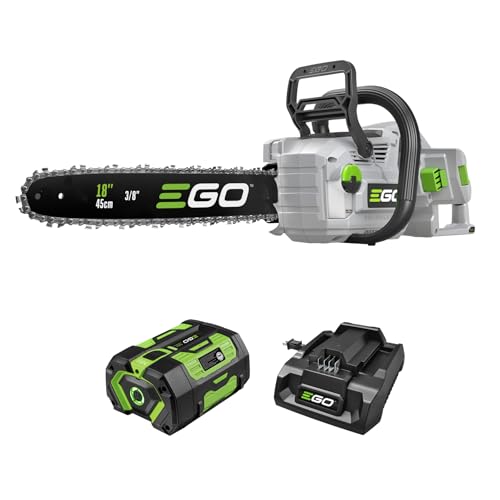
EGO POWER+ CS1815 — Easy Starting With an 18-Inch Bar
For beginners who want to skip the pull cord and fuel mix, and who may already own EGO 56V tools. The kit includes a 6.0Ah battery and charger.
EGO describes the CS1815 as a 50cc gas equivalent with a 2500W brushless motor and an 18-inch bar. It lists up to 330 cuts on a 4x4 per charge with the 6.0Ah battery, an EGO figure under its own conditions. An LED display shows speed modes and the chain tension dial needs no tools. EGO’s product page gives no weight, so check the manual if weight matters to you. It sits in the mid-range tier of our lineup. Read more in the CS1815 profile.
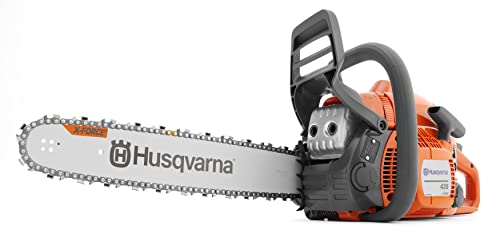
Husqvarna 435 — A Compact Gas Saw to Grow Into
For beginners who want a gas saw for yard work and firewood and are ready to handle fuel mixing, a pull start and hearing protection. It is the entry-level tier of our ranking.
The Husqvarna 435 has a 40.9 cc engine, 2.2 hp, a 16-inch bar and weighs 9.78 lb without the bar and chain, according to Husqvarna. It lists Smart Start and air purge to ease starting, an inertia-activated chain brake and a side-mounted chain tensioner. The page lists 102 dB(A) at the operator’s ear. Gas saws demand more from a beginner, but this one is on the small side. California buyers should check emissions status on the listing; the saw’s CARB classification is not stated on the pages we read, and the state’s Small Off-Road Engines program covers engines of this type. See the Husqvarna 435 profile.
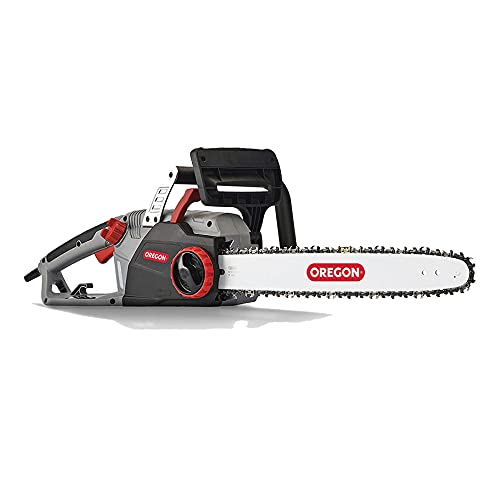
Oregon CS1500 — A Corded Saw With No Starting Routine
For beginners with small yards and an outlet nearby who want instant starts and a chain you can resharpen on the saw. It is the budget tier of our lineup.
Oregon lists a 15 amp, 2400W motor, an 18-inch bar, a chain brake, tool-less tensioning and an automatic oiler, with UL certification stated by Oregon. Its PowerSharp system lets you resharpen the chain in 3 to 5 seconds, which helps because a dull chain makes a beginner push harder. You need an outdoor-rated extension cord of the gauge the manual calls for, and cord management is part of the job. Oregon publishes no weight on the page we opened. OSHA’s fact sheet says extension cords must be sized according to the chainsaw maker’s instructions. See the Oregon CS1500 profile.
DEWALT DCCS621P1 — A 12-Inch Saw for Limbs
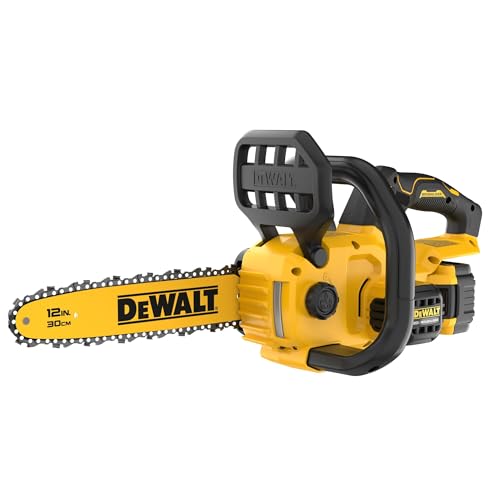
For beginners who already own DEWALT 20V MAX batteries and mostly cut branches and tree limbs rather than logs.
DEWALT says the DCCS621P1 is designed for jobs like cutting tree limbs and branches, with a 12-inch low-kickback bar and chain and a brushless motor. DEWALT’s page lists a DCB205 battery and a tensioning tool in the kit and gives no weight, only the phrase “lightweight design”. It is not for large logs. Check the listing to see whether a charger is included. Details are in the DCCS621P1 profile.
How to Choose
- Mostly limbs near the house, outlet available: the Oregon CS1500, or the DEWALT 12-inch if you own DEWALT batteries.
- Storm cleanup and some firewood, no fuel: the EGO CS1815.
- Regular firewood or no power nearby: the Husqvarna 435, with training and gear.
- Big trees or anything near wires or a roof: call a certified arborist.
For heavier saws, see the full ranking.
Sources
- OSHA QuickCard: Chain Saw Safety
- OSHA Fact Sheet: Working Safely with Chainsaws
- OSHA 29 CFR 1910.266 Logging operations
- Oregon: ANSI B175.1 and replacement chain
- Oregon: Chainsaw safety and the kickback danger zone
- University of Arkansas Cooperative Extension: chainsaw safety (FSA-1009)
- EGO POWER+ 18” Chain Saw (CS1810 / CS1815) official product page
- Husqvarna 435 official product page
- Oregon CS1500 official product page
- DEWALT DCCS621P1 official product page
- CARB Small Off-Road Engines program
Frequently asked questions
What is the best type of chainsaw for a beginner?
For most homeowners, a battery saw with a 16- to 18-inch bar is the easiest place to start. It has no pull cord, no fuel mix and no choke, so there is less to learn before the first cut. A corded electric saw is simpler still but tied to an outdoor-rated extension cord, and a small gas saw makes sense if you have no outlet or battery system and want runtime without limits.
What bar length should a beginner choose?
Many first-time buyers do well with a bar in the 14- to 18-inch range. Husqvarna lists a recommended bar length of 13 to 18 inches for its 435, and the EGO CS1815 and Oregon CS1500 both use 18-inch bars. A shorter bar is lighter and easier to control, and a bar only needs to be a little longer than the wood you cut. Match the saw and bar to the job, as the University of Arkansas extension advises.
Do I need a chain brake?
Look for one. OSHA's chain saw QuickCard says gasoline-powered chainsaws must be equipped with a protective device that minimizes kickback, and OSHA's logging rules for employers require a chain brake on gas saws. Oregon lists a chain brake on the CS1500, Husqvarna lists an inertia-activated brake on the 435, and EGO lists an automatic chain brake on its 20-inch saw. A brake helps, but it does not replace good technique.
What protective gear do I need before the first cut?
OSHA's QuickCard lists hand, foot, leg, eye, face, hearing and head protection. In practice that means cut-resistant chaps or leg protection, a hard hat with a face shield or safety glasses, ear protection, gloves and sturdy boots. Avoid loose clothing that can snag.
Is a battery chainsaw powerful enough for a homeowner?
For limbs, storm cleanup and light firewood, yes. EGO says the CS1815 makes up to 330 cuts on a 4x4 per charge with its 6.0Ah battery, a manufacturer figure under its own conditions. Large trunks and long days of cutting are where gas saws and bigger batteries pull ahead.
Should a beginner cut down a tree?
No. Start with limbs and logs on the ground. OSHA lists trees with a heavy lean, trees on unstable ground and trees with rot as higher-risk work, and says tasks beyond your training cause accidents. For big trees, trees near a house or power lines and storm-damaged trees, hire a licensed, insured tree service or a certified arborist.